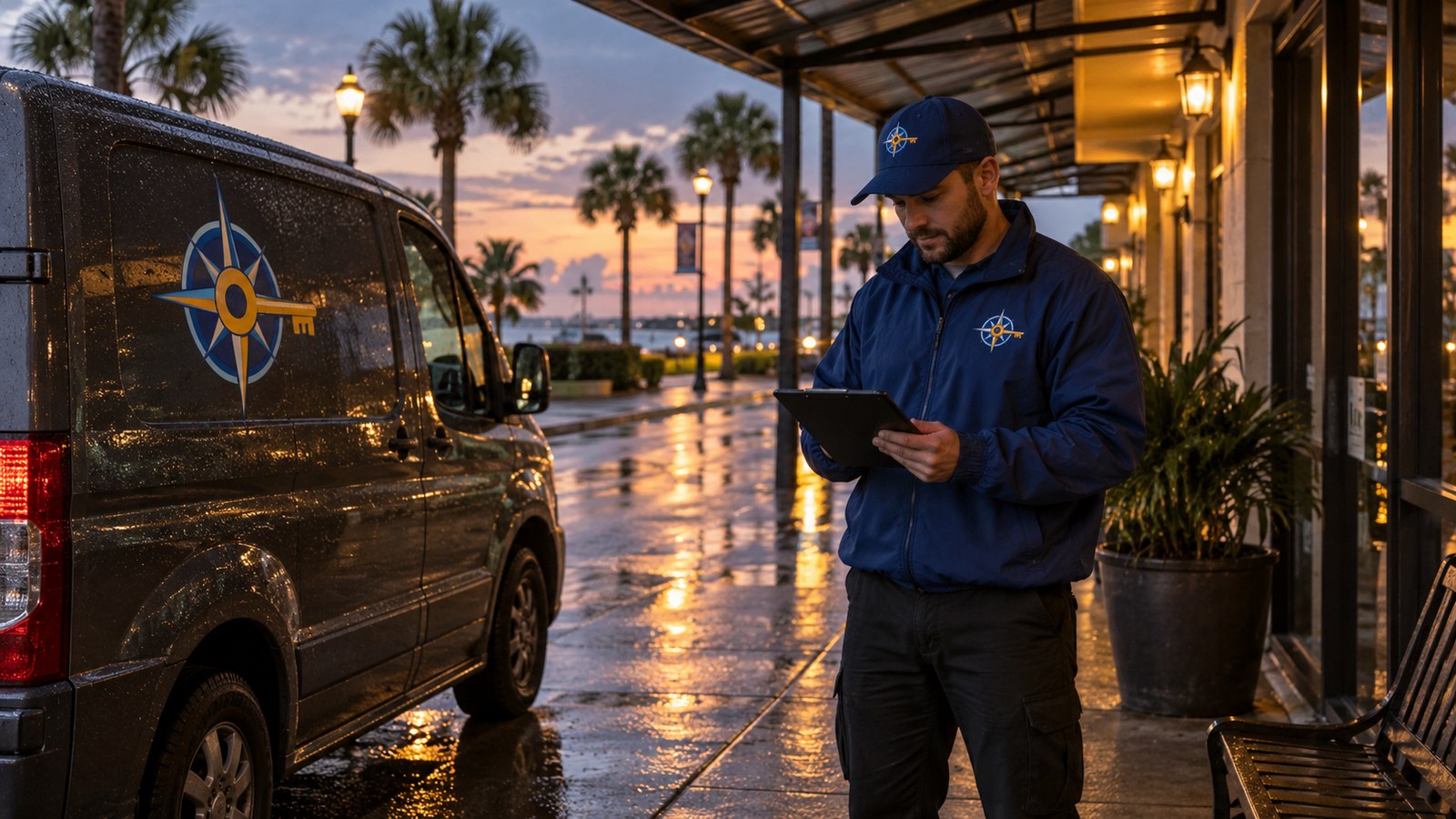
What to do in the first few moments of a lockout
The first thing worth doing is nothing dramatic. Take a breath, step away from the door or vehicle, and check the easy possibilities before you pay anyone to come out. Walk around the house and try every other door and window you know is meant to open, ask whoever lives with you whether they have a spare, and look in the pockets of the jacket or bag you carried earlier. Many lockouts end right there.
If the simple options fail, resist the urge to force anything. Kicking a door, prying a window or wedging a coat hanger into a car door can bend a frame, scratch paint, tear weatherstripping or damage the lock itself. A repair after a forced entry usually costs more effort than a careful opening would have. Techniques used by a trained locksmith are designed to leave the lock and the door as they were.
When you decide to call, do it from somewhere safe and well lit. Tell us where you are, what is locked, and whether anyone, such as a child, a pet or a person with medical needs, is inside. That detail changes how we handle the call. We will talk through your situation, explain what we can do, and ask you to call to confirm availability for the time you need.
Home and apartment lockouts
Most house lockouts come down to one of a few causes: keys left inside, keys lost somewhere along the day, a lock that has stopped turning, or a key that snapped off in the cylinder. Each calls for a different approach. A simple latch bolt on a standard entry door can often be opened without any damage at all. A broken key piece may need to be extracted first, and a worn lock may be better replaced once the door is open.
Apartments and rental properties add a wrinkle. If you rent, the lock may belong to the landlord or property manager, and many leases restrict changes to the hardware. We will ask about your situation honestly, and in some cases the right answer is to contact the manager first. If the door is yours to open, we can usually get you inside, and then talk about whether a rekey makes sense afterward.
Older Pensacola homes sometimes carry original mortise locks, glass knobs and wood frames that have settled over the decades. These need a gentler touch than a modern deadbolt. Salt air and humidity also leave their mark on hardware near the water, so a lock that fought you for months may simply be corroded inside. We can tell you plainly whether it is worth keeping or time to replace.
Car lockouts and lost vehicle keys
A vehicle lockout feels different from a house lockout, because you are often standing in a parking lot, on a roadside or outside a beach access with a limited amount of daylight, battery or patience. We start by asking where the vehicle is, what type it is in general terms, and whether the engine is running. Keys locked in a running car are a common call, and we treat that with extra care.
Lost car keys are a separate problem. Modern vehicles often use a transponder chip, a remote fob, or a smart key that talks to the car. A plain metal blank cannot start those vehicles, because the car expects a coded signal. Depending on the key type, a locksmith may need to cut a new key, program it to the vehicle, or both, and the process starts with confirming you own the car.
We will not guess at what your vehicle needs. Give us the make, model and year when you call, and tell us whether you have any working key left. A spare in a drawer at home makes the job simpler, since it can often be copied or used to add another. When every key is gone, programming takes longer, so ask us on the phone what to expect before anyone is sent out.
Business doors, storefronts and commercial hardware
A business lockout carries a different kind of pressure. Staff cannot get in, deliveries are waiting, or a manager is trying to secure a shop after an incident. Commercial hardware also varies more than residential locks: panic bars, heavy-duty cylinders, storefront glass doors with narrow stiles, restricted key systems and electric strikes are all common. The first job is working out what you actually have on the door.
Many commercial doors have a specific order of operation, such as a rim device on the inside, a mortise lock in the frame, and a separate deadbolt or keyed cylinder. A technician needs to know which part is failing. If the issue is a broken closer, a misaligned latch or a swollen frame, the lock may be fine and the real repair lies in the door itself. We will tell you when that is the case.
Business owners should also think beyond the immediate problem. If an employee left without returning keys, or a key has gone missing, rekeying the locks restores control without replacing every piece of hardware. We can talk through the options by phone, and describe what each involves. For anything that needs a visit to assess, the service call charge is explained before anyone is dispatched, so there are no surprises.
How a visit works from start to finish
It begins with a phone call. You describe the situation, we ask a handful of practical questions, and we explain what the work is likely to involve. For straightforward jobs, we can give a quote by phone. If the job is complicated, for example a damaged lock, an unusual vehicle, or a commercial system we cannot judge without seeing it, a technician visits to assess and the service call charge is explained before dispatch.
When the technician arrives, the first step is a conversation, not a tool. They will confirm who you are in relation to the property or vehicle, look at the lock or door, and tell you what they intend to do. If the plan changes after a closer look, they explain why and ask before continuing. You should never feel pushed toward more work than the problem calls for.
Once the lock is open, or the new key is cut or programmed, the technician tests it with you. They operate the lock several times, check that the door closes and latches normally, and make sure every key works smoothly. If something else is wearing out, they will mention it plainly, and leave the decision with you. Then you are on your way, with the lock working as it should.
What to have ready before you call
A little preparation makes the call shorter and the visit smoother. Start with your exact location. A street address is good, but at an apartment complex, a marina, a campus lot or a beach parking area, a nearby landmark or building number helps a great deal. If your phone shows your location, read it out. If you are in a vehicle, describe the lot and what is around you.
Next, describe what is locked and what has happened. Is it a front door, a side gate, a trunk, a storage room or a vehicle door? Did the key break, vanish, stop turning or get left inside? Details like a deadbolt versus a knob lock, or a key fob versus a metal key, save time and let us prepare the right tools before arriving.
Finally, gather anything that shows you have the right to open the lock. A photo ID with an address that matches the property, a lease, a utility bill, a vehicle registration or insurance card, or a business document can all help. You do not need a folder of paperwork, but the more you can show, the faster the ownership check goes. Our contact page lists these details in one place.
- Your exact location and a nearby landmark
- What is locked and what went wrong
- Vehicle make, model and year, if a car is involved
- A photo ID and something linking you to the property
- A safe place to wait while help is on the way
Why we check ownership and authority first
Every responsible locksmith asks who you are before opening anything, and we are no different. This is not suspicion about you personally. It is protection for the homeowner, the vehicle owner and the business whose property could be opened by someone with no right to it. A locksmith who skips this step is a risk to everyone, including the people who call for honest reasons.
For a home, we usually ask for a photo ID showing a matching address, or a document such as a lease or utility bill. For a vehicle, a registration, title or insurance card tied to your name is typical, along with an ID. For a business, an employee badge alone may not be enough, and we may ask for a manager, owner or a document that shows you can authorize the work.
If you cannot show authority, we may decline to open the lock, and we will explain why. Sometimes the answer is to bring the property manager, the landlord or a family member who can sign off. Sometimes it is to contact the police or a lienholder. We would rather lose a job than open a door we should not, and most customers appreciate that standard once they think about it.
Safety for you, your family and your property
Some lockout situations are about inconvenience, and some are about safety. If a child, a pet or a person who needs medical help is trapped inside a home or a vehicle, call emergency services first. They can reach people and animals in danger without waiting for anyone else. A locksmith is not a replacement for that call, and we will tell you so directly.
When you are waiting outside, choose a safe spot. In a parking lot at night, stay near lighted entrances or other people. On a roadside, keep away from traffic and use your hazard lights if the car has power. If something about a situation makes you uneasy, such as someone watching you or an unfamiliar person offering to help, trust that feeling and move somewhere public.
Safety also applies to the work itself. A good technician keeps the area clear, protects floors, doors and finishes, and avoids methods that put a lock or a vehicle at risk. For cars, that means being careful around airbags, wiring and weatherstripping. For doors, it means preserving the frame and strike. If a method could damage something, the technician should explain the tradeoff first and let you choose.
Gulf Coast conditions that wear on locks and keys
Living near Pensacola Bay and the Gulf means constant humidity, warm temperatures and salt in the air. That combination is hard on metal. Door hardware close to the water can corrode inside the cylinder, where you cannot see it. The first sign is often a key that sticks, a deadbolt that needs a shove, or a lock that works in the morning and balks by afternoon.
Hurricane season adds another layer. Homes and shops that have been boarded up, shuttered or hit by flooding sometimes come back with swollen wood frames, sticking doors and locks that have been soaked. If a door no longer lines up with its strike plate, the lock may be blamed when the real problem is the door. A technician can sort out which it is before you replace the wrong part.
A bit of care helps. Wipe key blanks and keep them dry, avoid forcing a stiff key, and have sticky locks looked at before they fail completely. A key that is worn down from years of use can also break off in the cylinder, so a fresh copy from a good original is a small, sensible step. Rental owners near the beach should check hardware between guests, because heavy use shows quickly.
Situations that bring people to call us
Some calls come from tourists and visitors who locked a rental car at a beach lot, or who cannot get into a vacation rental because a code box failed or a key was left behind. Others come from students and base-area residents who moved recently and have not yet sorted out spare keys. Pensacola has plenty of people in transition, and a lockout tends to find them at the worst moment.
Other calls follow a loss or a change. A wallet or purse goes missing with house keys inside, a roommate leaves and keeps a key, a breakup leaves one person unsure who can still enter, or a tenant moves out without handing everything back. In each of these cases, rekeying is usually the cleanest answer, because it makes every old key useless while the door and the lock body stay in place.
There are also the quieter repairs: a deadbolt that no longer throws all the way, a storm-warped door that rubs the frame, a gate lock that rusted shut, or a mailbox or file cabinet key that disappeared. None of these are dramatic, but each can turn into a lockout if ignored. Call us, describe it, and we will tell you whether it needs a visit or can be talked through.
Getting in touch and choosing the right next step
If you are reading this while locked out, the next step is simple: call us. Describe where you are, what is locked and what went wrong. We will ask a few practical questions, explain what the job probably involves, and tell you honestly whether we can help. Please call to confirm availability, because we would rather be straight with you than promise something we cannot keep.
If you are reading this calmly, with time to spare, use it. Think about whether every household member has a working key, whether spare keys sit somewhere sensible, and whether any lock near you is starting to stick. Fixing a worn lock on a quiet afternoon is far easier than dealing with it after it fails and strands someone outside.
For vehicles and businesses, the same planning applies. A spare car key made while you still have a working one is simpler than programming from nothing. A business that keeps a record of who holds keys can rekey quickly when staff change. Our contact page explains how requests work in more detail, including quotes by phone and the service call charge for visits.
Quick answers
Do you offer help at any hour of the day or night?
Availability can change from one day to the next, so the honest answer is to call us. When you do, tell us where you are and what is locked, and we will confirm whether we can send someone and when. We do not want to promise something we cannot deliver, so please call to confirm availability.
How much will it cost to get back into my house or car?
Many jobs can be quoted by phone once we understand the lock, the vehicle or the door. If the situation is more complicated and a technician needs to look at it, we explain the service call charge before dispatching anyone. You always hear the details before work begins, and you can decide whether to go ahead.
What proof will I need to show that the lock is mine?
For a home, a photo ID with a matching address, a lease or a utility bill usually works. For a vehicle, a registration, title or insurance card together with an ID is typical. For a business, we may need an owner or manager, or a document showing authority. If anything is missing, we will talk through what else could work.
Can you make a new car key if I have lost every one?
Often yes, depending on the vehicle. Many cars use transponder chips or smart keys that must be programmed, not just cut. Tell us the make, model and year when you call, and confirm that you own the vehicle. We will explain what the job involves and whether a visit is needed before anything is scheduled.
Should I rekey or replace the lock after losing my keys?
Rekeying changes the inside of the lock so old keys no longer work, and it is often enough when the hardware is in good shape. Replacement makes more sense if the lock is corroded, damaged or outdated. A technician can look at the lock with you and explain which choice fits your door and your situation.