

Why accessible hardware matters in everyday terms
Think about a person carrying a toddler and a bag of groceries, someone recovering from a wrist injury, a customer with arthritis, an older visitor using a cane, or a wheelchair user approaching a door alone. All of them benefit from hardware that works easily. A round knob that must be gripped and twisted is harder for many hands than a lever that can be pushed down with a forearm or an elbow.
Accessible hardware is therefore not a specialty feature for a narrow group. It is good everyday design. Customers who can enter without struggle are more likely to come back, and staff who can move through doors easily work more comfortably. The cost of better hardware is usually small compared to the difference it makes.
This page gives general awareness, not legal or code advice. Accessibility requirements come from federal and state standards and local building rules, and they apply differently to different buildings and uses. Your building official, architect or an accessibility consultant is the right source for what your premises must have. A locksmith can install and service the hardware you decide on.
Lever handles versus knobs
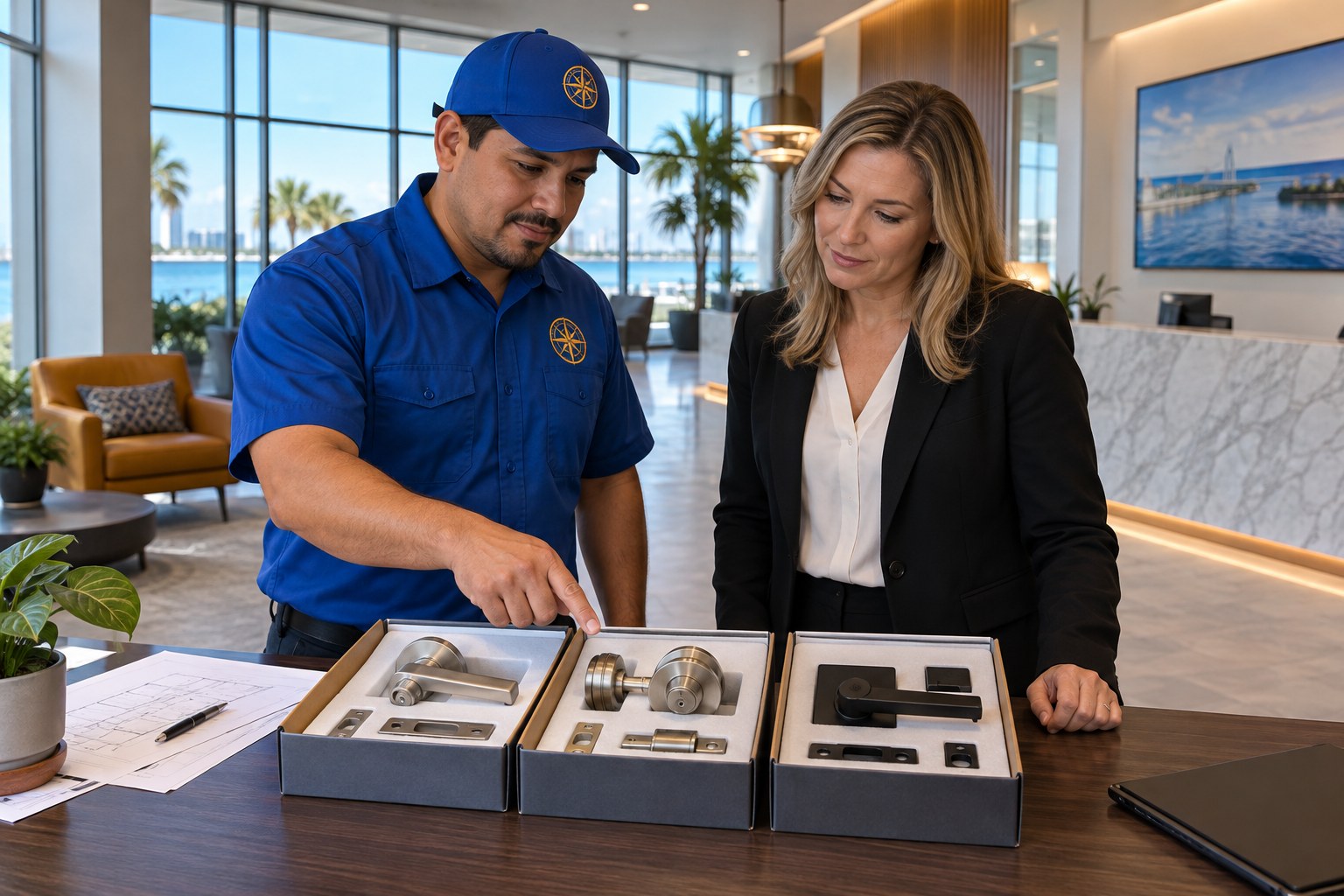
The most visible feature of accessible door hardware is the lever handle. A lever can be operated with a closed fist, an open hand, a forearm or an elbow, without gripping or twisting the wrist. Round knobs do not offer that flexibility. Accessibility guidance generally favors levers, and many commercial buildings use them throughout.
Not all levers are the same. A lever should return to its rest position and should not leave a gap that can catch clothing or a sleeve. Quality commercial levers have a return spring that keeps them level and a design that ends in a curve or return so that a loose cuff does not snag. Cheap levers can droop over time, which makes them harder to use.
Replacing knobs with levers is often a simple job. Many lock sets can be converted by changing the trim, while others need a new lock. A technician can look at your door and tell you whether a retrofit is possible. Keep in mind the finish and style so the new hardware matches the rest of the building.
Operating force and door closers
A door can have a perfect handle and still be hard to open if the closer is set too strong. Accessibility guidance sets limits on the force needed to open interior doors, and different limits for exterior doors that must resist wind and pressure. Closers have adjustments for closing speed, latching speed and sometimes opening force, and a trained technician can set them appropriately.
Weather affects doors. In humid weather along the Gulf Coast, doors swell and rub, and a door that opened easily in winter may be heavy in summer. Air pressure differences between inside and outside can also make a door difficult to open. A closer that fits the opening, with attention to pressure, helps.
If staff complain that a door is heavy, test it. Open it from a standing position and notice how much effort it takes. Check the closer arm, the hinges and the latch. Small adjustments often fix the problem. If the door needs a different type of closer or an automatic operator, a specialist can advise on options.
Clear space, thresholds and the approach
Hardware is only part of a usable doorway. A person in a wheelchair needs enough clear width through the door and enough space on each side to reach the handle and move out of the way of the swing. Thresholds that are too high can stop a wheelchair or catch a cane. Pushing and pulling space beside the latch side matters as well.
Specific dimensions are set by accessibility standards. This page does not list them, because they vary by situation and are updated over time. If you are making changes, consult your building official or a design professional. A locksmith can adjust hardware but does not determine whether a doorway meets the standard.
You can still spot obvious problems. Is the door reachable without crossing a step? Is there room beside the latch side to stand while opening it? Is the area in front clear of mats, planters or displays that block the path? Simple housekeeping fixes many access barriers with little more than a bit of attention.
Mounting height and reach
Hardware must be placed where people can reach it. Handles, locks and other controls that are too high are out of reach for a seated person, and ones that are too low are hard for people who cannot bend. Standards give a range of heights that works for most. Doors that were installed years ago, or modified, sometimes sit outside that range.
Adding a second lock or bolt at the top or bottom of a door can create a reach problem. A slide bolt installed high on a door for security may be unreachable for some people. If extra locks are needed, consider hardware within reach, or an arrangement that works with the main latch. Discuss with the technician and your authority.
Keypads, card readers and intercom buttons also need to be reachable. Placement at a comfortable height, with clear space in front, makes the entrance usable by more people. If you are installing electronic access, plan the height of the reader along with the door. A reader placed too high can be as much of a barrier as a locked door.
Locks, keys and people with limited dexterity
Turning a small key in a lock is difficult for people with limited hand strength or dexterity. Where a business expects customers or staff to use a key, consider options that are easier to operate. Large head keys, key holders that give leverage and keyless entry such as keypads or cards all reduce the effort needed.
For staff doors, a keypad lock avoids the need to hold a key and turn it. Some people also find keypads with larger buttons easier than small ones. Push button locks should provide clear tactile feedback and be mounted at a comfortable height. Think about whether the code can be entered with one hand and without twisting the wrist.
Thumb turns on the inside of a lock can also be hard to grip. Levers or larger turn pieces help. The inside of an exit door must be operable without special knowledge or effort, which is also a safety rule. A technician can suggest hardware that meets your needs while still delivering the security you want.
- Lever handles that return to a neat rest position
- Keypads or cards in place of small keys where suitable
- Closer settings that keep opening force reasonable
- Controls mounted within comfortable reach
Automatic operators and push plates
For busy entrances or doors that are very heavy, an automatic operator with a push plate or sensor lets people open the door with a light touch. These devices are installed by specialists, and they connect to power and sometimes to access control. The lock on such a door has to work with the operator so that the door is not left latched against it.
Common problems include operators that fail to open fully, doors that bump against the stop or sensors that do not detect a person. These issues belong to the operator contractor. The locksmith contributes to the lock and latch side, such as an electric strike or a lever with the correct function. Coordination between the two avoids finger pointing.
Push plates and actuators need to be mounted where they can be reached and used. They should be sturdy enough for repeated use and located so that a person can activate them without being in the swing path of the door. Good placement is as important as the hardware itself, and a design professional can help with the layout.
Balancing accessibility with security and safety
Sometimes accessibility, security and fire safety pull in different directions. A lever handle can be easier to operate and also easier to defeat in some circumstances. A door closer that is too light may not latch, while one that is too heavy is hard to open. Good design balances these needs rather than sacrificing one for another.
The answer is rarely to choose the weakest option. Commercial lever locks come in strong forms that resist forced entry while remaining easy to use. A deadbolt with a lever style thumb turn can be both secure and comfortable. A technician can explain how different hardware choices affect each goal, so you can choose with open eyes.
Always keep the rules for exits in mind. Required exit doors must open from inside without keys or special knowledge. Any change to those doors should be reviewed by your authority. The aim is a door that welcomes people, keeps unwanted visitors out and lets everyone leave safely in an emergency.
Restrooms, privacy locks and one-handed operation
Restroom doors and stalls bring a particular set of hardware questions. Privacy locks need to be usable by people with limited dexterity, and they need an emergency release in case someone is in trouble inside. A small slide bolt that requires pinching and sliding with two fingers is hard for many users, while a larger turn piece or a lever with a visible indicator is far easier.
Single occupant restrooms often have a thumb turn on the inside and a keyed or coin release on the outside. Check that the inside turn can be operated with one closed hand, and that it is not mounted so high or so close to the corner that a person in a chair cannot reach it. Staff should know where the emergency release is and how it works.
Weak or broken privacy locks cause real discomfort for customers and are an easy item to overlook. Include restrooms in your regular rounds. If a lock is sticky or a latch no longer catches, replace it promptly. A technician can fit hardware that suits the door, offers a clear indication of occupancy and works for as many users as possible.
Training staff to notice access problems
Employees see the doors every day, and they hear the comments of customers. A short conversation at a staff meeting about door hardware can produce a surprising list: the back door that sticks, the front handle that is hard for older visitors, the closer that slams. Encourage staff to report these items to whoever handles maintenance, and make it easy to do so.
Consider asking a few visitors, including people with disabilities if appropriate and willing, how easy your entrances are to use. Their perspective may highlight issues that a casual inspection misses. Listen without defensiveness, and treat suggestions as useful information. Often the fix is simple, such as adjusting a closer or replacing a handle.
Keep a short list of reported items and review it regularly. When several doors need attention, group them into one visit so the work is efficient. A steady, modest effort keeps access in good order and signals to customers that you care about their experience. That signal matters more than any single piece of hardware.
Getting professional guidance on larger changes
For small hardware swaps, you can usually proceed with a technician. For larger changes, such as widening a doorway, changing the swing of a door, adding operators or reworking an entrance, you need design and code input. An architect, accessibility consultant or building official can tell you what is required and what is permitted. Their guidance protects you from costly mistakes.
A locksmith plays a supporting role. Once the design is set, the technician can install the locks, set the closers and test the doors. If something does not fit as expected, the technician will tell you honestly and suggest alternatives. It helps to share the plans in advance so the right hardware is chosen.
Document what you do. Keep drawings, hardware specifications and invoices with your building records. If someone questions a door in the future, you can show what was done and why. Records also help the next owner or manager understand the history of the entrance and avoid repeating mistakes.
Older Pensacola buildings and retrofits
Many buildings in the Pensacola area are older, including historic structures with narrow doorways, raised thresholds and original hardware. Upgrading access in these buildings takes care. Replacing a historic knob with a lever may be acceptable in some places and not in others, depending on preservation rules that apply to the property.
Where full compliance with current standards is difficult, there may be alternatives or exceptions. These decisions belong to your building official or a qualified consultant, not to a locksmith. What the technician can do is adapt hardware to fit older doors, such as fitting a lever to an existing mortise lock or adjusting a heavy door so it swings more easily.
Plan carefully when working on old doors. Hinges may be weak, frames out of square and wood swollen. A lever handle will not fix a door that sticks. Address the cause first, then choose hardware. A thoughtful approach leaves the building both usable and respectful of its character.
A simple walkthrough of one entrance from a wheelchair height
The easiest way to understand accessibility problems is to approach a door slowly from the perspective of someone using a wheelchair, a walker or a cane. Start at the parking area and look at the path to the entrance. Is the surface smooth? Is the slope gentle? Is there a clear landing in front of the door? Then look at the handle, the weight of the door and the width of the opening. Many problems appear before you ever touch the hardware.
At the door, notice the details. Can you reach the handle without leaning awkwardly? Can you operate it with a closed fist, which is a useful test of whether it relies on a tight grip or twisting motion? Does the door close so quickly that someone moving slowly would be caught? Does the threshold create a bump? Is there space beside the latch edge for a chair to pull the door open? Small answers add up to an honest picture of daily use.
Take notes and photographs, then decide which items are simple adjustments and which need professional guidance. A locksmith can help with lever handles, closer adjustments, lock function and hardware height, while larger structural changes belong with a qualified design professional. Keep in mind that this page offers general awareness and not legal advice. Call us to confirm availability, and we will explain what hardware changes are practical, along with the service call charge before dispatch.
Maintenance for ongoing usability
Accessible hardware only helps if it keeps working. A lever that drooped over time, a closer that has drifted out of adjustment or a keypad with a dead battery can turn an accessible door into a barrier. Include accessibility in your routine door checks. Test each door as a visitor with limited strength might.
Salt air and humidity wear hardware faster. Check levers for looseness, springs for weakness and latches for sticking. Clean and lubricate on a regular schedule. A door that works smoothly is a courtesy to everyone. Keep notes on repairs so you can see which doors need replacement.
When you call for service, describe the door and what is difficult about it. Quotes are given by phone. If the job is complicated, a technician visits and the service call charge is explained before dispatch. Call us to confirm availability. Ownership or authority is checked before any lock work begins.
Quick answers
Do I have to replace all my door knobs with levers?
Requirements depend on your building, its use and local rules. Many businesses choose levers because they are easier to use. Ask your building official or consultant what applies, and a locksmith can handle the installation.
Can you adjust a door closer that makes a door too heavy?
Often yes. Closers have adjustments for speed and force. A technician can set them and tell you if the closer is the wrong type for the opening.
Is a keypad lock easier for people with limited hand strength?
It can be, because it avoids turning a small key. Choose a model with clear buttons and a comfortable height, and keep a mechanical backup. A technician can explain the options.
Can a locksmith tell me if my doorway meets the standard?
No. Compliance is determined by your building official or a qualified professional. A locksmith installs and services hardware, and can explain how it works.
How do I get a quote?
Call us and describe the door and what you want to change. Quotes are given by phone. If the job is complicated, a technician visits and the service call charge is explained before dispatch. Call to confirm availability.