

Why commuters are at risk of lockouts
A commute is a tightly timed routine. You wake up, gather your things, leave at a set time and park at work. Because the routine is so familiar, you stop paying attention to small details like where the keys are, and that is when mistakes slip in. A distraction as ordinary as a phone call can send keys onto a seat instead of into a pocket.
Commuters also deal with more transitions than most drivers. Leaving the house, entering the car, stopping for fuel or coffee, parking at work, leaving again at lunch and returning in the evening. Every transition is a chance to set keys down in the wrong place or to close a door with a fob still inside.
Weather and fatigue contribute. A rainy morning has you juggling an umbrella, a bag and a coffee. A long day leaves you tired and less careful on the walk back to the car. These conditions are normal and predictable, which means you can plan for them.
The good news is that commuters also benefit most from simple habits. Because the pattern is the same every day, a small improvement repeats thousands of times and quickly becomes automatic.
The one-pocket rule
The simplest habit is to give your keys one home on your body. Choose a pocket, a clip or a bag slot and use it every single time. When the keys are not in the car, they are in that spot. When you step out, you touch that spot before closing the door.
The rule works because it removes decisions. You do not have to remember where you put the keys, because they are always in the same place. Your hand learns the location, and a missing key is noticed immediately by feel rather than later by surprise.
Avoid placing keys in a bag that you will set on the passenger seat. Bags get left behind, and a bag with keys inside is easily locked in. Likewise, avoid the cupholder, the dashboard and the roof of the car. These are classic places to lose track of a set.
If you carry multiple items, such as a work badge, a parking card and a fob, consider a lanyard or a small organizer. A single, well-designed bundle is easier to keep track of than a pile of loose items.
Smart keys, push-button start and the walk-away problem
Many newer vehicles allow you to start the engine and lock the doors without taking the fob out of your pocket. This is convenient but has a quirk: you can leave the fob inside the car without noticing, especially if it slid out of a pocket or stayed in a bag on the seat.
Some vehicles prevent locking with a fob inside; others do not. Learn how yours behaves. Test with a spare fob in a safe moment, such as in your driveway. Knowing the rule is the best defense against an unpleasant surprise in a work parking lot.
If your car chimes or flashes when the fob is left inside, pay attention. Do not silence the warning without checking. That small signal often saves you from a lockout, and ignoring it is one of the most common reasons people end up stuck.
Keep the mechanical key accessible. Most fobs hide a small key blade, and the door has a hidden keyhole under a cover. Practice finding it once, so you are not learning on a cold morning with a deadline.
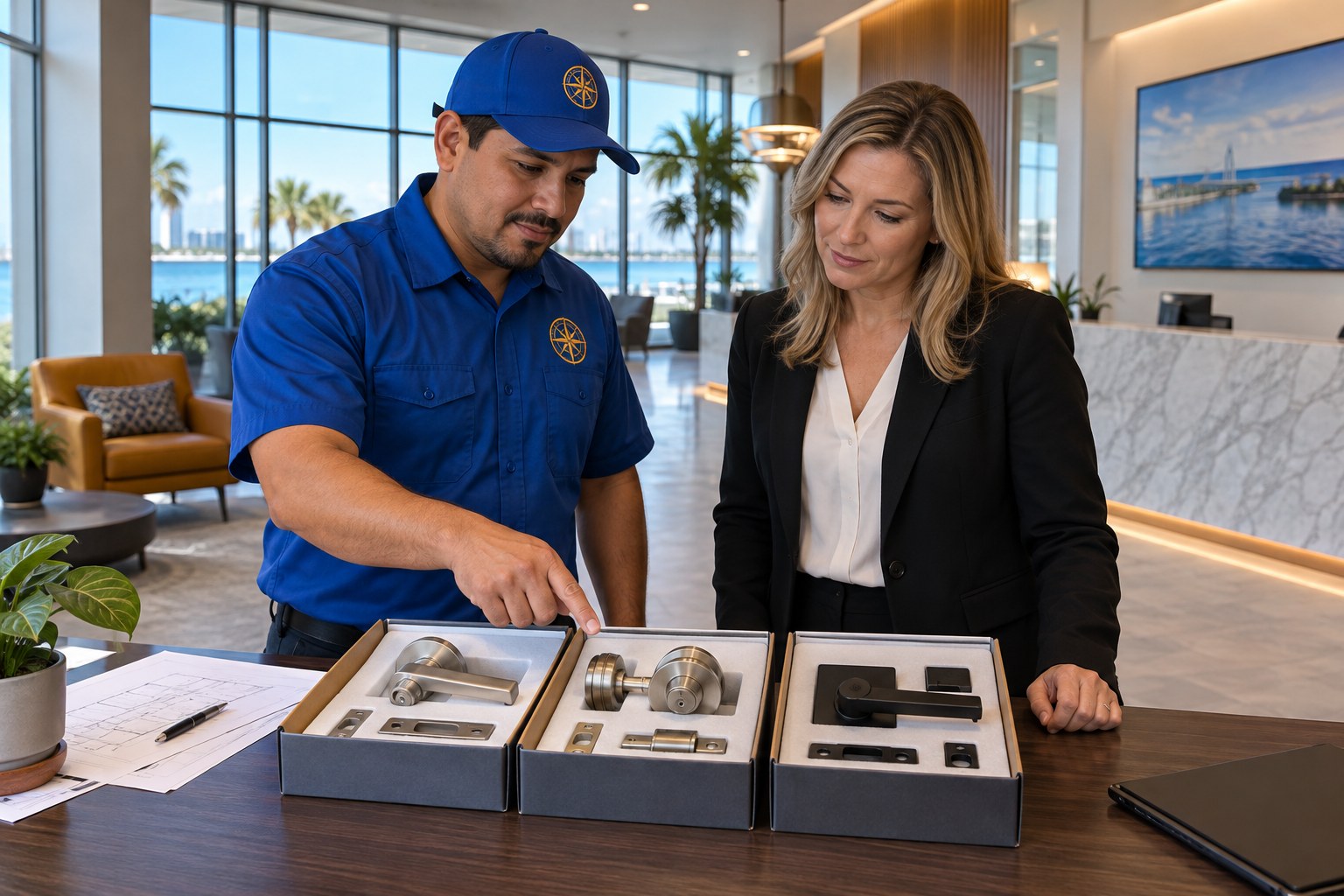
Parking at work and public lots
At work, where you park matters. A lot with lights, traffic and staff nearby is a safer place to deal with a lockout than a far corner or an empty deck. Choose a spot where you could comfortably wait for help.
Note your location. In a large garage, take a photo of the level and section. If you ever need to guide a technician, the information is ready. This also helps on the evening walk after a long day.
If your workplace has security staff, know how to reach them. They can often help a stranded employee, and some can verify identity for a technician. Ask your employer about the process, so you are not figuring it out in a hurry.
Remember that company parking may come with rules. If you drive a company vehicle or park in a managed lot, the owner or manager may have a say in who can open a vehicle. Mention this when you call, so the right authority can be involved.
Bridge traffic, roadside stops and safety
Commuters in the Pensacola area cross bridges and drive along busy roads. A roadside emergency on a bridge or shoulder is dangerous. If you must stop, move as far from traffic as possible, turn on hazard lights and exit the vehicle on the side away from the road.
If your key is lost or the car will not start on a bridge or a busy highway, call for help and stay in a safe location. Do not walk along traffic lanes. Often, the safest place to wait is outside the vehicle, behind a barrier, with your hazard lights on.
A lockout on the roadside is different from a lockout in a lot. Space is limited and traffic is close. Tell the dispatcher exactly where you are, including the direction of travel, the nearest mile marker or exit and any landmarks.
In severe weather, such as heavy rain or high winds, avoid staying near the water or exposed areas. Seek shelter if possible. A locksmith visit can wait until conditions are safe, and your wellbeing comes first.
Morning lockouts when time is tight
A morning lockout hits hardest because of the clock. You may have a shift to start, a child to drop off or a meeting to reach. Panic leads to poor choices, such as trying to force the door or prying at a window.
Take a minute to assess. Is there a spare key at home? Can a family member bring it? Can a coworker or a rideshare cover the commute while you handle the lock later? A short, practical plan is better than a rushed attempt at the door.
If you decide to call a locksmith, give a clear description of the problem and the time constraint. Call to confirm availability and ask what to expect. Quotes are given by phone, and honest answers about timing let you decide whether to wait or to find another way to work.
Inform your employer early. A quick message that you are dealing with a lockout and when you expect to arrive keeps trust high. Most employers understand that vehicle trouble happens.
Evening lockouts after a long day
By evening you are tired and less alert, and darkness adds risk. If you discover a lockout after work, move to a lit, visible spot. If you are alone in a quiet lot, consider going back inside to wait in a safe area.
Check your belongings. Your phone, wallet and badge should be with you. If your phone is inside the car, borrow one from a coworker or ask security for help. Do not wander off to find a signal in an unsafe area.
Be ready for the ownership check. The technician will ask for ID and registration or proof of authority. If your documents are inside the car, tell the dispatcher, and have digital copies available. This is another reason to keep photos on your phone.
Once the door is open, test the key and the lock. Before you drive off, confirm you have everything. Fatigue can lead to mistakes, so take a moment to settle before heading home.
Spare keys: where they belong
Every commuter benefits from a spare key. The question is where to keep it. The car is the wrong place, because a spare locked inside is no help. A hidden spare outside the vehicle is risky because thieves know the spots.
A better option is to leave a spare with a trusted person who lives or works nearby. A partner, a roommate, a coworker or a neighbor can bring it if needed. Make sure they know what it is for and keep it private.
At work, a spare in a secure locker or desk can be a lifesaver, but only if the space is safe and access is limited. Think about who else can reach it. A spare at the office that is visible to many people is a security gap.
For modern vehicles, a spare key may need programming. If you have only one working key, arrange a spare soon. Ownership is checked, and a technician may need to visit. Planning ahead is cheaper and calmer than an emergency.
Fob batteries and routine maintenance
Fobs run on small batteries that fade over time. A weak battery makes the fob respond slowly or only at short range. If you notice this, replace the battery before it fails. It is a quick job in most cases and prevents a lot of frustration.
Check the fob's physical condition. Cracked cases, worn buttons and loose parts are signs it is aging. A fob that has been dropped many times may stop working suddenly. Replace worn fobs before they fail at a bad time.
Keep the key blade and the ignition clean. A worn or bent key can stick in the ignition. If your key feels rough, have a fresh copy cut from the original. Ownership is checked for any key made.
Include key checks in your routine vehicle care. When you change the oil or check the tires, test the spare, check the fob, and note any changes. A few minutes now saves hours later.
Carpools, shared vehicles and family cars
Commuters who share rides face their own risks. When several people use a vehicle, keys pass between them, and confusion arises about who holds what. Agree on a system, such as one key holder per trip, and stick to it.
For a family car, set clear rules. Where are the keys kept at home? Who takes the spare? What happens if a teenager drives? A simple plan prevents arguments and saves time when something goes wrong.
If the vehicle is registered to someone else, make sure the driver can show permission. A photo of the registration and a message from the owner can be enough to establish authority. Keep this on your phone.
For company-shared vehicles, follow the employer's key policy. Report lost keys quickly, and let the manager decide whether re-keying is needed. Good communication reduces risk for everyone.
Working with a locksmith on a workday
When you call, state your location, your vehicle, and your constraints. Mention if you are at work, in a public lot or on the roadside. Tell the dispatcher about any safety concerns, such as traffic or weather.
Expect an ownership check. For a vehicle, that means photo ID and registration or similar proof. If the vehicle is not yours, the owner may need to confirm. Having documents ready saves time.
Quotes are given by phone. If a job is complicated, such as a lost key for a vehicle with a transponder system, a technician visits and the service call charge is explained before dispatch. Ask what is included so you know what to expect.
After the work, keep your receipt and test the key. Make a plan for a spare. A calm, organized response turns a disruption into a short pause in your day.
A short commuter checklist
Before leaving home: keys in the one pocket, fob battery fine, spare with a trusted person, documents on your phone. This takes seconds and covers the basics.
When you park: take the keys, check the pocket, lock the car, note your location. At lunch, repeat. A routine of touching the pocket each time you step out becomes automatic.
If something goes wrong: stay safe, check for people or pets inside, retrace your steps, call someone with a spare, and call us if needed. Call to confirm availability and have your documents ready.
After the incident: change one thing. A new spot, a lanyard, a spare, a reminder. The aim is to make the next morning smoother than the last.
Bad weather commutes and storm days
Coastal weather can change a commute in minutes. A summer downpour reduces visibility and turns parking lots into shallow ponds, and a hurricane warning can send everyone home at once. In these conditions, lockouts become more stressful because staying outside is uncomfortable or unsafe.
On rainy days, pay extra attention to your keys. Hands are full, you are hurrying, and a wet fob slips easily. Slow down at the car door, stand under cover if you can, and make the key check before you shut the door. A few seconds under a dry spot is better than a soaking.
When storms are forecast, think ahead about the vehicle. Park away from trees and low spots if possible, and keep a spare key reachable. If you evacuate or leave work early, take your keys and any fob with you, and avoid leaving them in a jacket that stays behind.
If a lockout does happen in bad weather, move to shelter and call. Tell the dispatcher about the conditions, and call to confirm availability. Technicians travel on the same roads, and honest information helps everyone decide the safest time and place for the work.
Teaching new drivers in the household
A commuter household often includes a teenager learning to drive or a relative sharing a car. New drivers are more likely to lock keys inside, lose a fob or leave the lights on. Spend a few minutes teaching the basics before they take the car alone.
Show them where the spare is kept, how the mechanical key works and what to do if the car will not open. Practice once together in the driveway. A calm demonstration is far more effective than a lecture, and it gives the new driver confidence.
Make sure they know whom to call and what to say. Give them a short written note: who owns the vehicle, where the registration is stored on the phone, and which number to ring. If they are stranded, they can describe the situation clearly and avoid a panic.
Remind them never to accept help from strangers who offer to open the car, and never to leave a vehicle running with a pet or child inside. A short conversation at the start can prevent a long evening on the roadside later.
Quick answers
How can I stop locking my fob in the car?
Use one dedicated pocket, touch it before every door closes, and learn how your vehicle behaves when a fob is inside. Heed warning chimes and keep the mechanical key accessible.
What should I do if I am locked out on a busy road or bridge?
Move as far from traffic as possible, turn on hazard lights and wait outside the vehicle on the safe side. Give the dispatcher your exact location and direction of travel. Call emergency services if anyone is in danger.
Where is the best place to keep a spare key?
With a trusted person who lives or works nearby, not in the car and not hidden outside. A secure locker at work can also work if access is limited.
Do you need proof of ownership if the car is a family vehicle?
Yes. Photo ID and registration, or permission from the registered owner, are needed. Keep a photo of the registration on your phone and ask the owner to send a confirmation message if they are not present.
My fob battery seems weak. Should I wait?
Replace it soon. A weak battery can fail at a bad moment. If the fob stops working, use the hidden mechanical key to open the door and have a technician test the fob.