
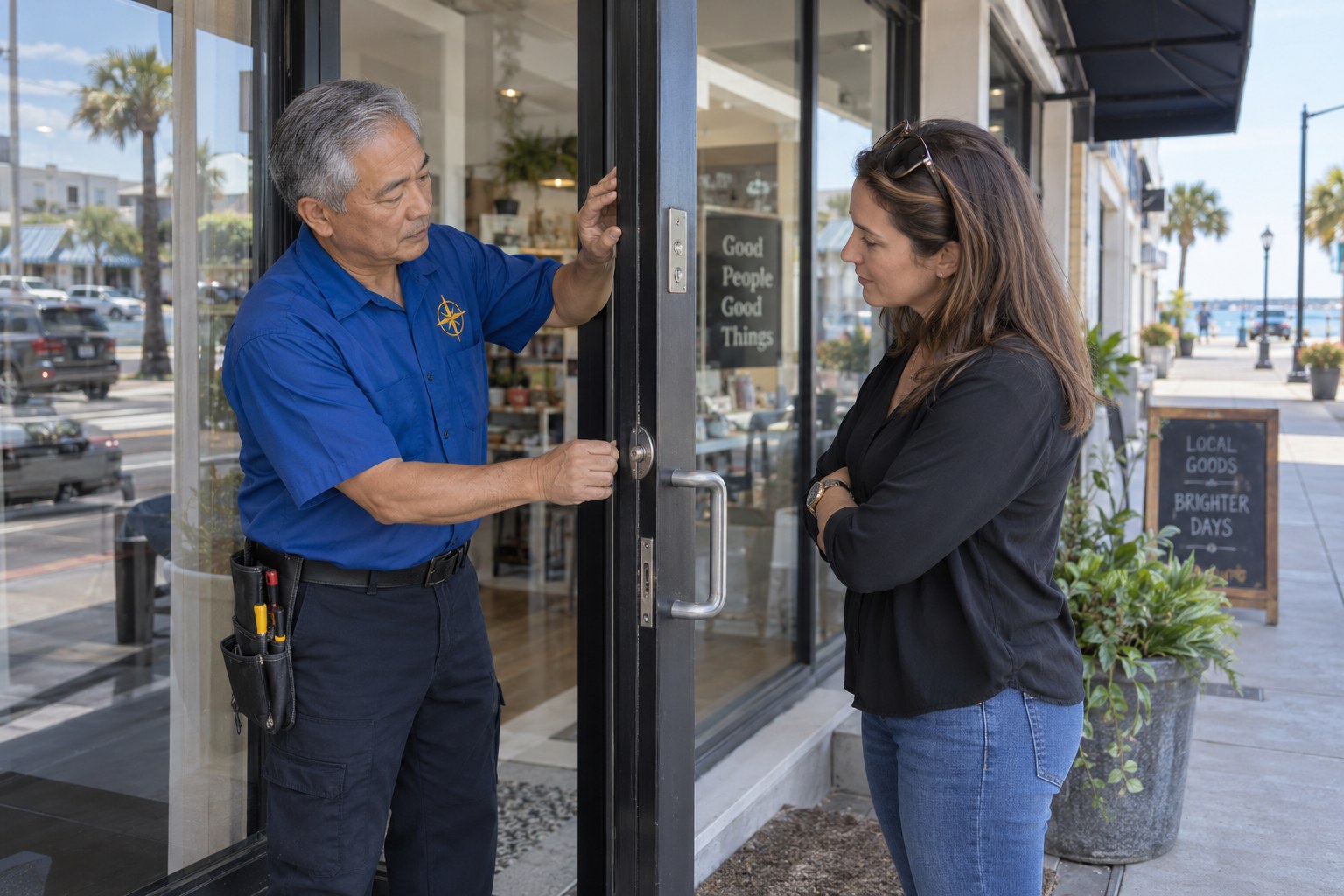
Start with what the key opens and who might have it
Not every lost key carries the same risk. A key that vanished from a locked drawer at home is very different from one that fell out of a pocket in a parking lot with your address on the tag. Think about where it was lost, how long ago, and whether anyone could connect it to the lock it opens.
Also think about what the key opens. A front door key is more serious than a shed key. A key to an office with equipment, records or cash is more serious than a closet. Some keys open several locks, such as a house, a garage and a mailbox, and losing one reveals access to all of them.
Consider who else had the key. Former roommates, contractors, cleaners, tenants and relatives may hold copies. A lost key joins that list of unknown holders. If you do not know how many copies exist, the real risk is larger than it seems.
Taking a few minutes to list these facts gives you a clear basis for deciding. The decision is yours, and we give honest advice rather than pushing a particular solution.
Option one: do nothing, with eyes open
Sometimes the best choice is to wait. If you lost the key inside your own home or car, and you are confident it will turn up, patience may be reasonable. Search thoroughly, including pockets, bags, couch cushions, vehicles and places you visited. Many lost keys reappear after a calm search.
If you decide to wait, set a deadline. A few days is reasonable for a key lost in a place you control. After that, treat it as truly lost and decide again. Do not let weeks pass in uncertainty, because an unlocked risk is still a risk.
While you wait, take simple precautions. Lock all doors, use any deadbolts and consider a temporary measure such as a door brace at night. Tell household members what is happening. Watch for anything unusual, and note it.
Doing nothing is a reasonable choice only when the risk is low. For a key lost in public, or with an address attached, it is usually not wise. When in doubt, move to one of the next options.
Option two: rekey the existing locks
Rekeying changes the internal pins of a lock so that the old key no longer works and a new key does. The lock hardware stays in place. It is often the most economical way to restore security after a lost key, and it can be done on site by a technician in a short visit.
Rekeying works well when the locks are in good condition and of reasonable quality. It also lets you match several locks to one key, which is convenient for a house with a front door, a back door and a garage entry. You carry one key instead of three.
It does have limits. If a lock is worn, damaged or poorly made, rekeying may not be the best route. Rekeying also does not improve the lock itself. A cheap lock stays cheap. If you have doubts about the hardware, a replacement may be wiser.
We check ownership or authority before rekeying, because changing a lock affects who can enter. Have ID and proof, such as a lease, a deed, a utility bill or a letter from the owner. For businesses, a letter on company paper from someone with authority is useful.
Option three: replace the hardware
Replacing the lock means installing a new cylinder, deadbolt or set. This makes sense when the old hardware is worn, damaged, outdated or of low quality. It is also a chance to upgrade, for example to a deadbolt with a stronger bolt or a lock with better resistance to common attacks.
Replacement also resolves unknowns. If you do not know how many copies of the old key exist, or the lock has been rekeyed many times, a fresh set gives a clean start. New hardware also comes with new keys, and you control how many are made.
Consider the whole door. A strong lock on a weak door or frame has limited value. Check the strike plate, the screws, the frame and the hinges. A technician can advise on reinforcement. Often a few small upgrades add real strength.
Hardware choices depend on your door, your budget and your needs. We discuss options by phone and give quotes for straightforward jobs. For anything complicated, a technician visits and the service call charge is explained before dispatch.
Option four: change the system
For larger properties or businesses, the answer may be a different system. Master key systems let different people open different doors, with a master key for the manager. Electronic locks, keypads and card access allow you to give and cancel access without cutting keys at all.
Electronic systems are useful when many people need access, when staff change often or when keys are repeatedly lost. Deleting a code or a card is simpler than rekeying a lock. But electronics bring other considerations: power, batteries, backups and the need to manage accounts.
Smart locks for homes offer convenience, such as digital codes for guests and logs of who entered. They need care in setup and battery maintenance, and they should have a physical key backup. Choose reputable hardware, and avoid systems that cannot work during a power failure or a hurricane.
We can discuss the options and tell you honestly when a simple rekey is enough. Not every property needs a sophisticated system, and we do not push upgrades that do not suit your situation.
Homes: special considerations
For a single family home, the usual choice is to rekey the exterior doors. Do all of them at once, so that one new key works everywhere. Include the garage entry, the side door, the sliding door lock if it has a keyed lock and any storage or mailbox locks you want matched.
If you rent, talk to your landlord or property manager first. The lease may require permission, and they may prefer to handle it themselves. A change by a tenant without permission can cause problems. We check ownership or authority, and for rentals we ask for the landlord's consent.
For older homes, the locks may be old as well. Older mortise locks and historic hardware can be repaired or rekeyed in many cases, but parts may be limited. A technician can inspect them and tell you what is realistic. Saving original hardware is possible when it is in good shape.
After a hurricane or a move, review all your keys. Cleaners, contractors and storm repair crews often come and go. A rekey after such activity is a sensible reset. Keep a record of who holds each key.
Businesses: special considerations
A business has more people and more risk. A lost key to a shop, an office or a storage room may expose inventory, records, equipment and cash. The cost of a break-in often exceeds the cost of a rekey, so many owners choose to act at once.
Decide who needs access to what. A manager may need a master key, staff may need keys to specific doors, and cleaners may need limited access. A master key system can organize this clearly. Without it, a business can end up with a tangle of keys that no one can track.
Keep a key log. Record who holds each key, when it was issued and when it was returned. When someone leaves, collect the keys and update the log. If a key goes missing, the log tells you which locks are affected and how serious the issue is.
Consider alarms, cameras and lighting as part of the picture. Locks are one layer. We focus on the lock and key side, and we are happy to say when another trade is better placed to help. For commercial properties, we may need a letter from the owner or manager.
Timing and temporary measures
If you cannot change the locks immediately, take temporary steps. Add a door barricade or a security bar at night, use a secondary lock where possible and ask neighbors to look out. Tell the people who need to know. Temporary measures are not a substitute, but they reduce risk until the work is done.
Do not delay too long if the risk is real. A key lost with an address attached, a stolen bag with keys and ID or a key taken in a break-in calls for fast action. In those cases, rekeying should not wait for the weekend.
Call us to confirm availability and discuss timing. We do not promise arrival times, because it depends on the situation, but we do give honest information about what is possible. We will tell you if a temporary measure makes sense in the meantime.
If you are away from home, ask a trusted person to be present during the work, or arrange access with proof of authority. We always verify who is asking for service.
How the visit unfolds after you lose keys at home or work
The technician starts by checking identification and proof of ownership or authority. Then they inspect the locks, explain the plan and confirm the number of keys you want. For a rekey, they remove the cylinders, change the internal parts, test with the new keys and reinstall.
A typical visit includes testing each lock several times with the new keys, and confirming that the old keys no longer work. Ask the technician to demonstrate. Keep the old keys in a separate place until you are sure everything is right, then dispose of them securely.
If the technician finds worn or damaged hardware, they will explain options. You decide whether to proceed. A service call charge is explained before dispatch for complicated jobs. You should never feel cornered.
After the work, ask for advice on care and spare keys. Store spares securely, outside the building if possible, with a trusted person. Never hide a key near the door.
Pensacola context
Our climate affects locks. Salt and humidity corrode cylinders and bolts, so hardware near the coast ages faster. A lock that sticks or feels rough may be near the end of its life. Replacing it during a key change can be a good moment to upgrade to coastal rated hardware.
Rental properties and vacation homes see many guests and key handoffs. A rekey between seasons, or a switch to keypad locks, reduces the number of unknown copies. Property managers often choose systems that allow codes to be changed easily.
Hurricane preparation is a good time to review keys. Make sure you can lock up securely, have working keys for shutters, garages and storage, and keep copies of important keys with trusted people. After a storm, check your locks, since debris and water can affect them.
Whatever your situation, call us to talk it through. Quotes are given by phone for straightforward jobs. Honest advice is part of the service.
Gathering the facts before you call
Before you pick up the phone, collect a few details. How many locks are involved? What kind are they, such as deadbolts, knob locks or a commercial cylinder? Do you want one key for all of them? How many keys do you want made? Are there any special locks, such as a mailbox, a gate or a storage unit?
Note when and where you think the key was lost, and whether anyone knows your address. Mention who else holds copies. This helps the technician judge the urgency and recommend the right option. Be honest about anything unusual, such as a recent break-in or a dispute with a former tenant.
Have your proof ready. For a home, that might be a deed, a lease, a utility bill or a government letter showing the address. For a business, a letter on company paper, a lease or a business license can help. We need to be sure that the person asking is allowed to change the locks.
Call us to confirm availability and describe all of this. Quotes are given by phone for straightforward jobs, and we explain what will happen at the visit. If the job is complicated, a technician visits and the service call charge is explained before dispatch.
After the lock change: keeping control of keys
A new set of locks only helps if you manage the new keys. Decide how many keys exist, and keep a record. Give a key to someone only if they need it, and write down who. A simple list on paper or in a locked note on your phone is enough for most households.
Store a spare in a secure place away from the door. A hidden key near the entrance is the first place a thief looks. Better options include leaving a key with a trusted neighbor or relative, or using a secure lockbox in a discreet location, as explained in the lockbox guide.
When someone no longer needs access, collect the key or change the lock. Former roommates, ex partners, contractors and employees are common sources of unknown copies. A polite request to return keys is normal, and a rekey is reasonable if a key is not returned.
Review your locks once a year. Try each one, check the strike plates and screws, and make sure the keys still turn smoothly. If anything feels rough, address it before it fails. Small attention keeps the system reliable.
Emergency and lockout situations tied to lost keys
Losing a key often leads directly to a lockout, especially if it was the only one. If you are outside your home or business and cannot get in, stay calm. Check every door and window you know is legitimate to use, and think about whether a family member, a neighbor or a manager holds a spare.
If you must call for help, have your identification ready, and be prepared to show proof that you live or work there. A technician will check ownership or authority before opening any door. This may feel slow, but it protects you from a stranger gaining entry to your property.
After the door is opened, consider rekeying while the technician is there. It is often more efficient to combine the steps, since the lock is already accessible. You can discuss it on the phone before the visit, so the technician brings what is needed.
If a child, a pet or a person who needs help is inside, call emergency services first. This is an emergency and should not wait for a locksmith. For ordinary lockouts, call us to confirm availability, tell us the address and describe the door and lock.
Quick answers
Do I really need to change my locks if I lose a key?
Not always. If the key was lost inside your own home and will likely turn up, waiting a short while is reasonable. If it was lost in public, or has your address on it, rekeying is wise.
What is the difference between rekeying and replacing a lock?
Rekeying changes the internal pins so a new key works and the old one does not, keeping the same hardware. Replacing installs new hardware. Rekeying is often simpler; replacement suits worn or weak locks.
Can all my doors use one key?
Yes, in many cases we can rekey several locks to match one key. This is convenient for homes and small businesses. We check ownership or authority before doing so.
What do I need to show before a lock change?
Photo ID and proof that you own or control the property, such as a deed, lease, utility bill or a letter from the owner. For businesses, a letter from someone with authority helps.
Is a smart lock better than a rekey?
It depends. Smart locks help when many people need changing access, but they need batteries and care. For many homes, a simple rekey is enough. We give honest advice about what fits.