
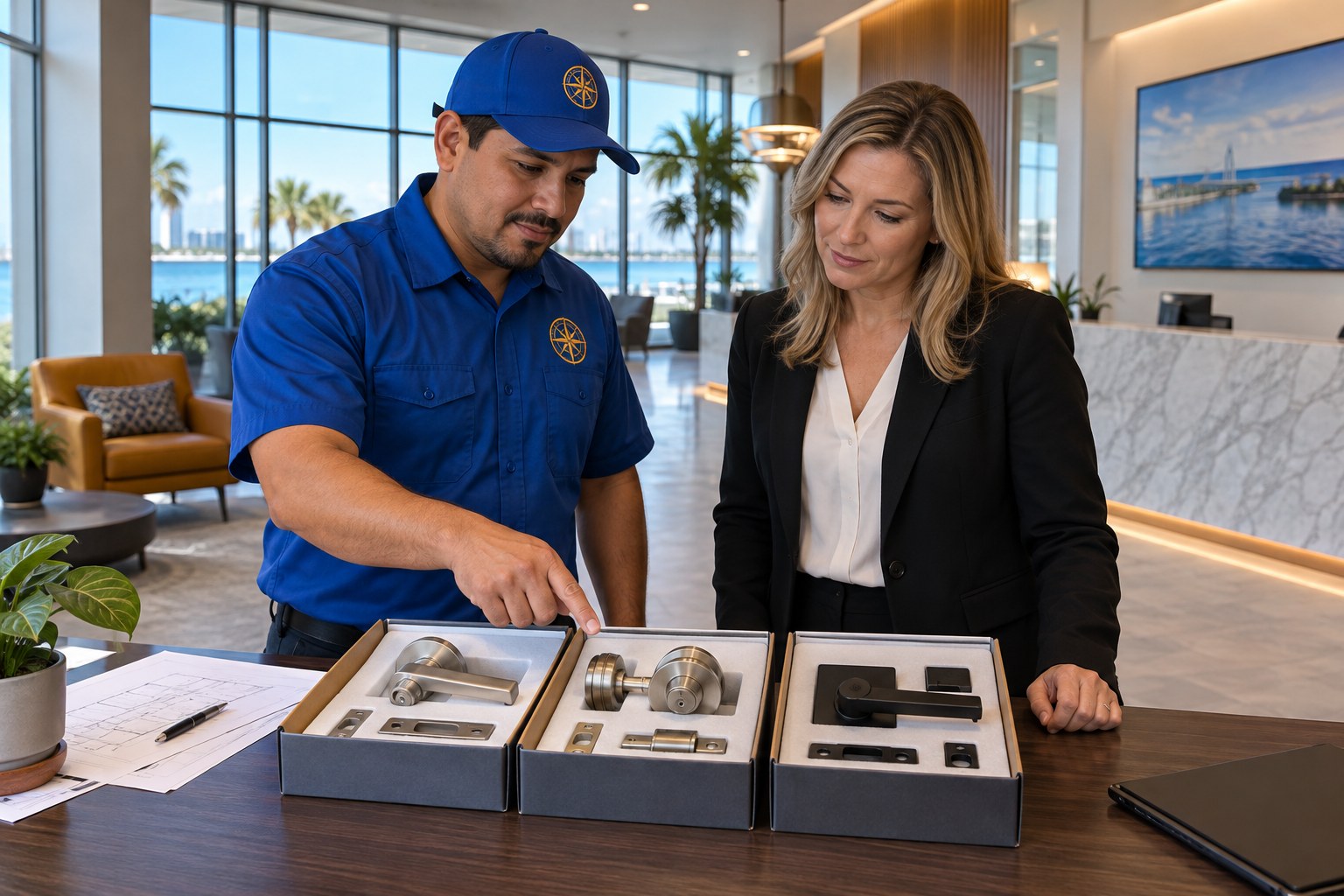
What an electric strike is
A traditional strike plate is a fixed piece of metal in the door frame that receives the latch. An electric strike replaces it with a plate that has a movable keeper. When power is applied, the keeper moves out of the way, and the latch can slip past without turning the handle. When power is removed, the keeper returns and holds the latch.
The door still has its normal lockset. Someone with a key can open it, and someone inside can usually leave by turning the handle. The strike adds a second way to open the door from outside: an electronic signal. That is why strikes pair so well with intercoms, keypads and card readers.
Because the door stays latched when the strike is not powered, the strike does not hold the door closed with magnetic force. The mechanical latch does that. This is an important difference from magnetic locks, covered on another page.
Fail-secure and fail-safe types
Electric strikes come in two main behaviors, and choosing the right one matters. A fail-secure strike stays locked when power is lost. The door remains latched against entry from outside, though people inside can still leave. This is common on doors that must stay secure during an outage.
A fail-safe strike unlocks when power is lost. The keeper releases and the latch can pass freely. This is used where the door must open in an emergency, such as certain fire rated or life safety situations, though rules vary. It requires power to keep the door locked.
Which one suits your door depends on the building, the use and the rules that apply. A technician can explain the options. We do not decide code questions for you, and we recommend checking with the building authority when a door is part of an exit path.
A mistake in the type can cause trouble. A fail-safe strike on a door that should stay secure leaves the building open during a power cut. A fail-secure strike where the door must release can trap people outside.
- Fail-secure: stays locked without power
- Fail-safe: releases when power is lost
- Choose by use of the door and applicable rules
- Test behavior during a power cut
Where electric strikes are used
Offices commonly use them at reception doors. Staff can let visitors in with a button at the desk. Medical and professional offices use them to control access to back areas. Apartment buildings and shared offices use them with intercoms for front doors.
Retail stores may use them on stockroom or employee doors, linked to a keypad or card reader. Schools and churches use them to control entrances during certain hours. The common thread is a door that needs to be locked most of the time and opened conveniently by approved people.
Strikes can also work with timers, so a door unlocks during business hours and locks afterward. This reduces the chance of a door being left unlocked at night. A technician can help set up the schedule through the access system.
They are a practical, low profile choice. Unlike magnetic locks, they do not add a large device to the door. They fit in the frame and look similar to a regular strike.

How the strike fits the lockset
The strike must match the latch. Different locksets use different latch shapes, such as cylindrical latches, mortise latches or rim latches. Strikes are made for each type. Installing the wrong type results in a door that does not latch or release properly.
The frame matters too. Wood, hollow metal and aluminum frames need different cutouts and mounting. A technician measures the frame and the latch position carefully. Even a small error in alignment can cause the latch to bind on the keeper.
Some strikes are designed to work with a deadlatch, a feature that protects the latch from being pushed in by a tool. Make sure the strike supports this so security is not reduced. A latch guard on the door edge is a further protection.
The result is a system where lockset, strike and frame work together. Choosing them as a set is better than mixing parts. Ask the technician to check compatibility before ordering.
Power, wiring and controls
An electric strike needs a power supply, usually low voltage, and a control device. Wiring runs from the strike through the frame and wall to a power supply and a switch, keypad or reader. Good wiring practice prevents overheating and voltage drop.
A power supply with a backup battery keeps strikes working during short outages. This matters for fail-safe types and for doors that need to stay operable. Check how long the battery lasts and replace it on schedule.
The control can be a simple button, a keypad, a card reader or part of a wider access system. Our pages on access control and keypad entry describe these options. The strike simply responds to the signal.
Protect wiring from damage. A cable that runs across a door hinge can fray. Use a protective loop or a door cord designed for the purpose. A technician routes wires safely and hides them where possible.
Common problems and troubleshooting
The most common problem is a door that does not release. Causes include a dead power supply, a loose wire, a misaligned strike or a latch that binds under pressure. If the strike clicks but the door does not open, alignment is the likely cause.
Another problem is a strike that buzzes constantly or overheats. This can mean the wrong voltage, a failing coil or a stuck keeper. Do not ignore heat or odd smells. Turn off power and call a technician.
A door that opens without a signal suggests that the latch is not engaging fully or that the strike was installed in the wrong mode. Check that the door closes completely. A closer that is too weak may leave the latch resting on the keeper.
Intermittent faults often come from wiring. Vibration, moisture and heat can loosen connections. Check terminals and connectors. Coastal humidity makes corrosion on connections common.
Alignment and door condition
A strike works only if the door sits correctly in the frame. A door that has sagged or warped changes the gap between latch and keeper. Even a few millimeters can cause binding. Before blaming the strike, check the hinges and the closing action.
Adjustable strikes allow some fine tuning. The keeper can be moved slightly, and the faceplate can be shifted. A technician adjusts them with the door closed, testing the release after each change.
Latch pressure also matters. If the door is pushed against the latch when the strike releases, friction can hold the latch in place. Some doors need the closer set so that it does not pull too hard on the latch. Balance is important.
Wood and hollow metal frames can wear around the strike. Replace worn frame material or reinforce the cutout. A solid frame keeps the strike stable.
Security considerations
An electric strike weakens the frame slightly because it requires a larger opening. A good installation reinforces the area. A heavy duty strike and a long throw latch resist forced entry better than a basic model.
The wiring is another consideration. If wires are exposed outside the door, a person can bypass the strike. Keep wiring inside the frame and the secured side. Use a controller on the secure side of the door.
Keypads and readers installed on the outside should be tamper resistant. A reader that can be pulled off the wall gives access to the wiring. A technician can mount them securely and protect the connection.
Good practice includes regular testing. Try the door, check the keeper, and confirm that it locks properly after release. A strike that sticks open is a hidden hole in your security.
Hurricane season and power outages
Storms bring power loss, and doors with electric strikes need a plan. Know whether each door fails safe or secure. Keep mechanical keys available so staff can enter and exit when power is out. Test backup batteries before storm season.
Water can damage strikes and wiring. Doors facing the weather should have protected connections and sealed junctions. After flooding, inspect the strike and the power supply before turning on power. Do not energize wet equipment.
Salt air corrodes metal quickly. Use corrosion resistant finishes on exterior strikes and apply protective coatings to terminals. Inspect them after storms.
After a storm, test every electrified door. Check the release, the latch and the closer. Call us if anything behaves oddly. Quotes are given by phone, and complicated jobs are explained before dispatch.
Replacing and upgrading
A failing strike can often be replaced with the same model. Measure carefully and match the voltage and type. If the old model is no longer available, a technician can suggest a compatible one and adjust the frame cutout.
Upgrading may make sense if you are adding card access or if the old strike is weak. A modern strike with better sealing and stronger parts can improve reliability. Consider heavier duty models for high traffic doors.
Think about the whole system. A new strike on an old power supply or an unreliable controller may not fix the underlying issue. A technician can test the entire chain from switch to strike.
Ownership or authority is checked before work on a business door. For leased spaces, confirm who is responsible for door hardware. Call us to confirm availability.
Strikes compared with magnetic locks
Electric strikes and magnetic locks both allow remote release, but they work differently. A strike holds a latch mechanically, so the door stays closed even without power if fail-secure. A magnetic lock holds the door with magnetism and releases when power is cut.
Strikes work well on doors that need to be secure with minimal fuss. Magnetic locks suit doors where fast release is critical, such as some glass doors, but come with safety and code concerns. Our page on magnetic lock service explains.
The choice depends on the door type, the frame and the rules that apply. A technician considers these and recommends. Do not choose by price or appearance alone.
In some cases, both are used on different doors in the same building. Consistency in controls and power supplies helps maintenance.
Intercoms, buzzers and visitor control
Many strikes work with an intercom or a buzzer system. A visitor presses a button, the person inside speaks or looks at a camera, and a button releases the door. This is common at offices, clinics and small apartment buildings. It lets staff screen visitors without leaving their desks.
The strike is only one part of the visitor system. A speaker, a camera, a control panel and wiring all play a role. If the door does not release when you press the button, the cause may be anywhere in the chain. A technician tests each piece and finds the fault without guessing.
Think about how visitors are handled. Do they wait outside, in a lobby or in a small vestibule? A vestibule with two doors provides extra control, since the second door only opens after the first has closed. The design depends on the building and its use.
Make sure staff know how to use the release and how to handle problems. A simple card at the desk with instructions helps new employees. Ownership or authority is checked before installation, and quotes are given by phone.
Maintenance and testing schedule
Electric strikes work for years, but they benefit from attention. Test each strike monthly by triggering the release and watching the door open. Listen for the click and look for hesitation. A strike that is slow or noisy is trying to tell you something.
Twice a year, inspect the faceplate and keeper for wear, dirt and corrosion. Clean with a soft brush. Check that screws are tight. In humid coastal conditions, a light application of a recommended lubricant on moving parts helps.
Check the power supply and backup battery at the same interval. Batteries wear out, and a dead battery means a failed door during an outage. Record the date of replacement and plan the next one.
Keep a log of tests and repairs. It shows patterns, such as a door that fails every summer, and helps a technician diagnose faster. Call us to confirm availability when anything seems off.
Glass doors and narrow frames
Storefront and glass doors have narrow aluminum frames, and fitting a strike there is harder than in a wide wood frame. Special narrow strikes exist, designed to fit slim profiles. The strike body may mount in a separate housing or require a custom plate. Not every strike can go in every frame.
Mullions between double doors can hold a strike as well. A removable mullion carries the latch keeper for both doors, and an electric version can release them on a signal. These are specialized parts and need careful measurement.
On glass doors, work near the glass requires care. Drilling and cutting must avoid stress on the panes. A technician protects the glass and plans the work to avoid vibration. If a door is custom or unusual, tell us when you call so we can plan the right parts.
Because the frame is thin, reinforcement is limited. Consider other measures, such as a stronger latch, an alarm contact and good lighting. Call us to talk through the options for your door.
Booking the technician for an electric strike job
An electric strike often announces what is wrong through sound. A clean click when the button is pressed, followed by a door that still will not open, points at the mechanical side: a latch bound against the strike lip or a keeper that is not retracting far enough. A buzz without a click suggests the solenoid is receiving power but cannot move. Silence usually means power or control wiring is not arriving at all. Describing these sounds on the phone helps the technician arrive with the right parts and tools.
The door itself offers clues too. Stand at the doorway and pull gently on the handle while a helper presses the release. If the door opens easily under a light pull but not otherwise, the latch is probably under pressure from the frame, which is an alignment problem instead of an electrical one. A door that sags slightly or drags on the floor can shift the latch position by only a few millimeters, enough to defeat a strike with tight tolerances. Noting whether the problem is worse in humid weather or after the door closes hard is useful.
A few details are worth writing down before calling: whether the strike is fail secure or fail safe if you know, where the release button or controller sits, whether the door is part of a fire rated opening, and whether anything else shares the same power supply. Do not bypass wiring or jam the keeper open to get by, because a jammed keeper leaves the opening unsecured. Call us to confirm availability, describe what you heard and saw, and we will explain what a visit would involve and how the service call charge works before dispatch.
Getting a strike problem in front of a technician
Tell us about the door: material, lockset type, the control device and the symptoms. If you know the strike model, share it. This helps the technician bring the right parts.
Make sure someone with authority is available. We check ownership or authority before work. For shared buildings, the property manager may need to approve.
Expect testing. The technician will cycle the strike many times, check alignment and verify the behavior in a power loss. Ask to see the door working before they leave.
Quotes are given by phone. If a job is complicated, a technician visits and the service call charge is explained before dispatch. Call us to confirm availability.
Quick answers
What is the difference between fail-safe and fail-secure strikes?
A fail-secure strike stays locked when power is lost. A fail-safe strike unlocks when power is lost. The right choice depends on how the door is used and the rules that apply.
Why does my strike click but the door will not open?
Usually the door is binding on the keeper. Alignment, a sagging door or a latch under pressure are common causes. A technician can adjust the strike and the door.
Can an electric strike be added to an existing door?
Often yes. The frame needs a cutout, and the lockset must be compatible. A technician measures and advises. Ownership or authority is checked first.
Does a strike work during a power outage?
It depends on the type and the backup power. Fail-secure strikes stay locked without power but can usually be opened with a key. Plan for outages before storm season.
Is a strike secure?
A well installed strike with a reinforced frame and protected wiring offers good control. It is one layer of security. Door and frame strength matter too.